WhatsApp For More
+6 (012) - 524 8258

WhatsApp For More
+6 (012) - 524 8258


A wonderful series developed by Maurice Hinson that contains the most popular intermediate selections by favorite composers, and features performance suggestions and analyses.

A rich selection of Thirty-six of Debussy's best songs, including 'Beau Soir', 'Mandoline', 'Les Angelus' and 'Dans Le Jardin'.

Author : Claude Debussy, Maurice Hinson
Dr. Hinson analyzes such works as "Golliwog's Cakewalk" and "Dance de la Poupée," and gives helpful guidance on how to achieve a musical performance.

Author : Claude Debussy, Maurice Ravel
Tags : 2 PianosDuet
In the "Nocturnes" for orchestra and women’s chorus, composed between 1897 and 1899, Debussy realized his idea that musical form should arise organically from the material. Utilizing a tripartite structure, he made references to the symphony while simultaneously distancing himself from it by substituting the motivic-thematic elements with a range of nuanced timbres. The movement titles "Nuages" (clouds), "Fêtes" (festivals), and "Sirènes" (sirens), which draw inspiration from nature and culture, hint at the programmatic music that was prevalent during that era. Nevertheless, Debussy was not focused on tone-painting; instead, he emphasized poetic imagination. The arrangement of this impressionistic masterpiece for two pianos, completed by Ravel in 1909, posed a challenge that the young composer navigated with remarkable skill. Alongside Louis Aubert, he also successfully premiered the work on 24 April 1911 at the Salle Gaveau in Paris. We were fortunate to engage Debussy expert Denis Herlin for the first critical edition of the arrangement, with Andreas Groethuysen providing the fingerings.

Tags : Piano Duet
Ravel held Debussy's famous orchestral work in the highest esteem, going so far as to express in an interview his fervent wish to die to the sounds of this "unique marvel in the whole of music." Since Debussy had already published a two-piano version, Ravel undertook an arrangement for piano four-hands in 1910, which was published that same year by Fromont in Paris and made an impact in its own right. For this Henle Urtext edition, we have recruited Debussy specialist Denis Herlin as editor to evaluate all available sources. The fingerings were provided by Andreas Groethuysen of the renowned Tal & Groethuysen Duo.
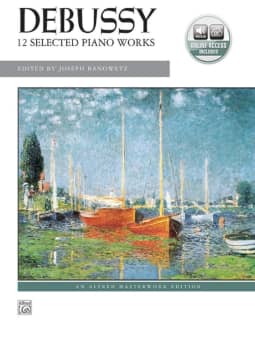
This collection features twelve renowned compositions by Debussy, meticulously edited and performed by Joseph Banowetz. It includes a comprehensive preface that offers insights into the compositional and performance aspects of each piece, accompanied by audio recordings by Banowetz himself. The works featured are Arabesques No. 1 and No. 2, La fille aux cheveux de lin from Préludes, Book I, Page d'album, Rêverie, selections from Suite Bergamasque including Clair de Lune and Prélude, as well as selections from Children's Corner such as Doctor Gradus ad Parnassum, Golliwogg's Cake-Walk, Le petit nègre, The Little Shepherd, and Serenade of the Doll. Joseph Banowetz, a distinguished graduate with First Prize honors from the Vienna Akademie für Musik und darstellende Kunst, has established himself as a prominent piano recitalist and orchestral soloist across five continents.


