Online Catalogue

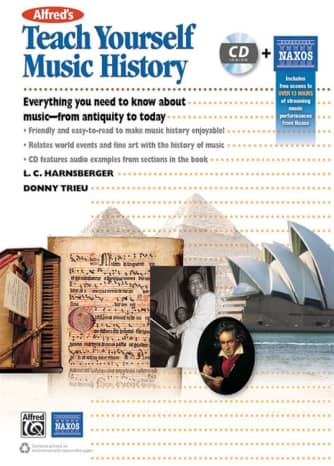
Teach Yourself Music History c\w CD

  • Book Code : TXCD - ALF40142

  • Instrument(s) : Reference
  • Publisher : Alfred Music
  • ISBN10 : 038081448404
  • ISBN13 : 9780739092712
RM 128.90

Description

Teach Yourself Music History offers a delightful exploration of the key periods in Western music, including the Medieval, Renaissance, Baroque, Classical, Romantic, and Modern eras. The book enhances the learning experience by incorporating world history timelines and visual art examples, effectively connecting musical developments to significant historical events. Additionally, readers gain access to over 13 hours of streaming audio featuring complete movements and entire works highlighted in the text. The high-quality Naxos recordings encompass iconic pieces such as Handel's "Hallelujah Chorus," Bach's Toccata and Fugue in D Minor, Mozart's Eine kleine Nachtmusik, Beethoven's Emperor Concerto, Dvořák's Symphony No. 9 (from "The New World"), Joplin's "The Entertainer," and the main theme from Star Wars, along with Gregorian chant and more. By the end of this journey, you will have a solid understanding of the most influential composers and their music, laying the groundwork for a lasting appreciation of classical music.
Songs / Content

  • INTRODUCTION
  • The Basics of Music
  • A Little About Music Theory
  • Instruments---How Music Is Performed
  • Music in the Ancient World
  • What History Hasn't Told Us Yet
  • THE MEDIEVAL PERIOD
  • History and Happenings
  • Music and Arts in the Medieval Period
  • Developments in Music
  • The Early Roman Catholic Church
  • Sacred Music in the Early Medieval Period
  • Musical Modes
  • Gregorian Chant
  • Early Notation
  • Secular Vocal Music
  • Polyphony
  • Ars Antiqua
  • Consonance and Dissonance
  • The Canon
  • The 13th-Century Motet
  • Ars Nova
  • Guillaume de Machaut
  • Instrumental Music
  • Looking Ahead
  • THE RENAISSANCE PERIOD
  • Music and Arts in the Renaissance Period
  • Early Renaissance
  • The Burgundian School
  • Guillaume Dufay
  • The Flemish School
  • Josquin des Prez
  • The Protestant Reformation
  • The English Reformation
  • William Byrd
  • The Counter-Reformation
  • Giovanni Pierluigi da Palestrina
  • Late Renaissance
  • Carlo Gesualdo
  • Musical Instruments in the Renaissance Period
  • THE BAROQUE PERIOD
  • Music and Arts in the Baroque Period
  • The Birth of Tonality
  • Jean-Philippe Rameau
  • The Four Major Composers of the Baroque Period
  • Georg Philipp Telemann
  • Antonio Vivaldi
  • George Frideric Handel
  • Johann Sebastian Bach
  • The Development of Opera
  • The Florentine Camerata
  • Claudio Monteverdi
  • Jean-Baptiste Lully and French Opera
  • Other Opera Styles and Composers
  • The Da Capo Aria
  • Vocal Music
  • Religious Vocal Music
  • Liturgical Vocal Music
  • Non-Liturgical Vocal Music
  • The Dance Suite
  • The Sonata
  • The Concerto
  • Keyboard Music
  • Organ
  • Clavichord
  • Harpsichord
  • THE CLASSICAL PERIOD
  • Defining "Classical"
  • The Influence of the Age of Enlightenment on Music
  • Musical Characteristics
  • The Pre-Classical Period
  • Homophony
  • Alberti Bass, and Dynamics
  • The Viennese School
  • Franz Joseph Haydn
  • Wolfgang Amadeus Mozart
  • Ludwig van Beethoven
  • The Importance of Form
  • Sonata Form
  • Other Forms
  • Piano Music
  • Chamber Music
  • The String Quartet
  • Other Chamber Music
  • Piano Concertos
  • Concertos for Other Instruments
  • The Symphony
  • Form
  • Instrumentation
  • Early Symphonies
  • Contributions from the Viennese School
  • Classical Opera
  • Opera in the Pre-Classical Period
  • Christoph Gluck's Opera Reforms
  • Mozart's Operas
  • Vocal Music Beyond Opera
  • Sacred Music
  • Vocal Music in the United States
  • THE ROMANTIC PERIOD
  • The Influence of Art and Literature on Music
  • Beethoven's Influence on the Romantic Period
  • The Development of Instruments
  • Nationalism in Music
  • Early Romantic Period and the Art Song
  • Franz Schubert
  • The Symphony, Concert Overture, and Symphonic Poem
  • Program Music and Developments to the Symphony
  • The Fantastic Symphony
  • Pyotr Ilyich Tchaikovsky and the Concert Overture
  • Richard Strauss and the Symphonic Poem
  • Performers as Composers
  • Niccolò Paganini
  • Franz Liszt
  • Frédéric Chopin
  • Romantic Opera
  • The International Reach of Opera
  • Italian Opera
  • Gioachino Rossini and Early Romantic Opera
  • Giuseppe Verdi and Opera in the Mid-19th Century
  • Giacomo Puccini and Verismo
  • French Opera
  • German Opera
  • Richard Wagner and Music Drama
  • The Operetta
  • Other Types of Music in the Romantic Period
  • Nationalism Throughout the World
  • Music for Marching Band
  • THE MODERN PERIOD
  • New Instruments
  • New Styles
  • Transitioning from the Romantic Period
  • Impressionism
  • Claude Debussy
  • Maurice Ravel
  • Erik Satie
  • Les Six
  • Atonality
  • Arnold Schoenberg and a New Musical Language
  • Twelve-Tone Music
  • The Second Viennese School
  • Alban Berg
  • Anton Webern
  • The Influence of the Second Viennese School
  • Russian Music
  • The Russian Revolution and Its Impact on the Arts
  • Igor Stravinsky
  • Sergei Prokofiev
  • Dmitri Shostakovich
  • Nationalism in the Modern Period
  • Hungary
  • England
  • Spain
  • The United States
  • The Jazz Era
  • Early Influences
  • Plantation Songs and Spirituals
  • Ragtime
  • The Blues
  • Jazz Bands
  • George Gershwin
  • Duke Ellington and Big Band Jazz
  • Other Jazz Styles
  • Influence of the Blues and Jazz on Popular Music
  • Experimental Music
  • Early Experimental Innovators
  • Electronic Music and Musique Concrète
  • Minimalism
  • Terry Riley
  • Philip Glass
  • Steve Reich
  • John Adams
  • Other Types of Music in the Modern Period
  • Modern Opera
  • The Musical
  • Film Music
  • FINAL WORDS

Brands